Kraken is our pick if you want to schedule your first crypto purchase after payday. Coinbase suits people paid on the 1st and 15th who also have cash for a purchase today. Bitpanda Savings is worth comparing if you want a euro savings plan funded by SEPA direct debit. Your pay dates and the amount of crypto in the order preview can narrow the choice faster than an exchange’s headline trading fee.
Kraken, Coinbase and Bitpanda offer scheduled purchases. For exchange-connected automation, compare 3Commas for conditional entries, Bitsgap for a ladder of orders and Coinrule for a schedule with custom filters. All six providers offer automation and have public publisher affiliate programs. We compared their published instructions and fee disclosures as of November 25, 2026. The examples below use hypothetical orders. We did not place live trades.
Recurring-buy apps compared
| App | Available schedule | Before confirming |
| Kraken | Daily, weekly, fortnightly or monthly | Select a future start if needed. |
| Coinbase | Weekly, 1st and 15th, or monthly | Allow for an immediate purchase. |
| Bitpanda | Weekly, fortnightly or monthly | Check when SEPA collection begins. |
Check the schedule against your next two paydays. “Every two weeks” produces 26 scheduled purchases in a typical year. “Twice a month” produces 24. At $50 each, that is a $100 difference in annual contributions before fees.
Kraken for a first buy after payday
Suppose you open the app on Tuesday and your wages arrive on Friday. In Kraken’s recurring order setup, you can choose a future start date. Set the first purchase for Saturday if you want a day between the expected deposit and the debit. The available intervals include daily, weekly, every two weeks and monthly. Every two weeks is particularly convenient if your paycheck arrives on alternate Fridays.
Use the regular Kraken app or website with a verified account. Kraken Pro has a separate trading interface and does not offer these recurring orders. Select the asset and amount, change the default one-time frequency and check the start date on the review screen. Kraken shows the transaction fee before confirmation. A cash balance and a card are among the funding options. Check the methods offered for your currency and location.
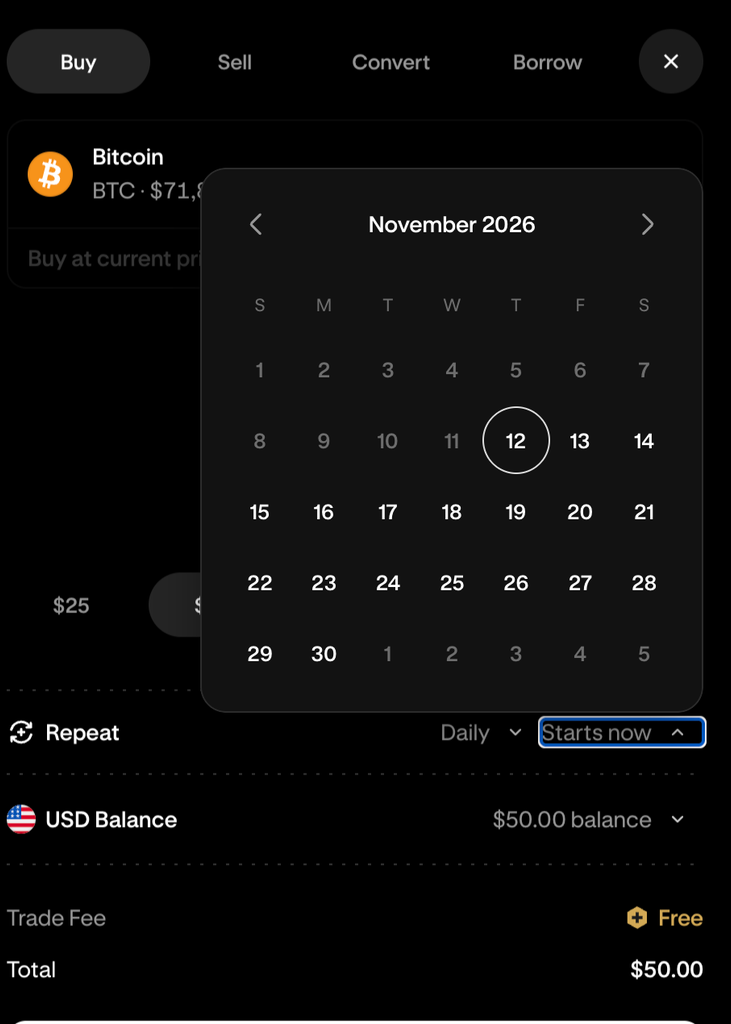
Kraken’s recurring-buy setup. Review the frequency before confirming the purchase.
Who should look elsewhere? A buyer paid on two fixed calendar dates may find Coinbase’s twice-monthly option a closer match. If cost drives your decision, save Kraken’s recurring-order quote before comparing it with another app. A Kraken Pro spot fee tells you little about the quantity the recurring order will deliver.
Coinbase for purchases on the 1st and 15th
Coinbase offers weekly, monthly and twice-monthly recurring buys. The last option matters if, for example, your employer pays you on the 1st and 15th regardless of the weekday. A fortnightly schedule gradually drifts away from those dates. Coinbase lets you select them directly.
Have the first installment available before you confirm. Coinbase says a one-time purchase for the plan amount executes immediately at setup. If you have $50 set aside for next month and nothing available today, wait before setting up the plan. Changing its amount or frequency later requires canceling the existing schedule and creating another. Budget for the immediate order when you create the replacement.
In the buy screen, select Recurring buy, pick an eligible payment method and preview the purchase. Coinbase includes a spread in its simple-buy price and can charge a fee. The amount of BTC or ETH in the preview gives you a better comparison than the fee line alone. Keeping a familiar account can save setup time, but it is still worth checking what the same cash buys elsewhere.
Bitpanda Savings for euro direct debits
Bitpanda Savings lets eligible customers fund scheduled crypto purchases by SEPA direct debit. Its product page lists weekly, fortnightly and monthly intervals. That combination suits someone who wants a monthly euro debit without moving cash into an exchange by hand. Check your registered account entity first. Bitpanda’s help desk currently lists Savings as unavailable to customers registered under Bitpanda UK Ltd.
The debit and the purchase can fall on different days. Bitpanda says a pending SEPA transaction may appear in the EUR wallet up to ten days before execution. If your salary lands on the 25th, choosing the 26th as your purchase date leaves little cash-flow margin. Look at the planned collection and keep the money available ahead of it.
Pausing a plan also deserves a glance at the transaction list. A pending payment may still execute after cancellation. If you see a debit after switching the plan off, compare its status and scheduled purchase date before setting up another. For a non-euro bank account, include any currency conversion your bank charges when comparing the cost.
3Commas for buyers who want price-triggered entries
| Automation app | Best fit | Setting to check |
| 3Commas | Independent deals on several pairs | Funding needed across all pairs |
| Bitsgap | Buy orders at several prices | Size and spacing of averaging orders |
| Coinrule | Timed checks with market filters | Which conditions allow a buy or sale |
Choose 3Commas if you already hold cash or stablecoins on a supported exchange and can describe the market condition that should trigger a buy. Its DCA bot lets you choose an exchange, a trading pair and a direction. For someone accumulating bitcoin, those choices answer three practical questions: where the order will execute, what the bot will spend, and whether it can sell. Pick a BTC pair quoted in the currency you actually hold. A balance in another currency may be unavailable to that pair.
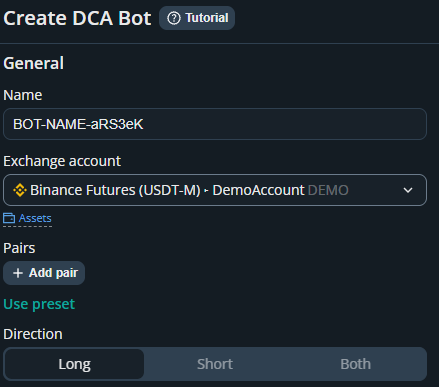
3Commas setup screen. Check the exchange, pair and trading direction before sizing your orders.
The averaging method matters just as much as the entry signal. At hypothetical BTC prices of $100,000 and $80,000, buying a fixed 0.001 BTC costs $100 and then $80. Spending a fixed $100 buys 0.001 BTC and then 0.00125 BTC. On 3Commas, look for “Fixed order value” if your budget is in dollars. Then inspect the order-size multiplier. With progressively larger orders, your last buy can require more cash than your first several buys together.
One setting can also apply across several trading pairs. Imagine allocating $40 for an opening order and $30 each for two follow-up buys. One fully filled sequence requires $100 before fees. Give BTC and ETH independent permission to run that sequence and the combined requirement reaches $200. If they fall together, both can call on the same cash. Review the required balance and the maximum number of simultaneous positions before turning the strategy on.
3Commas is the strongest fit here for someone who knows which entries and exits they want to automate. A reader who simply wants $50 of bitcoin every other Friday gets a closer match from Kraken’s recurring order. The difference becomes clearest in a quiet market: payday still arrives, while a price trigger can go weeks without firing.
Bitsgap for planning a ladder of buy orders
Bitsgap’s spot DCA bot gives you separate controls for the opening order and the buys that follow. Its setup guide starts with the exchange, pair, direction and investment amount. In the advanced settings, you choose the distance between averaging orders, the amount allocated to them and how many can sit on the exchange at once. These controls suit someone who can name the prices at which they would put more cash to work.
Consider a hypothetical first buy at $100 and limit buys at $96 and $92. If the market touches $96 and then rises, the lowest order may never fill. If the price drops through both levels in an afternoon, all three buys could execute before the next payday. That is a different cash commitment from spreading the same money across three Fridays. A limit on active orders controls how many are open at one time. The remaining orders can still require funding later.
There is another choice after a fill. Bitsgap can take profit on a position, with settings based on its average price or the opening order. If your target is to own more BTC in a year, read those exit settings carefully: an automated sale may increase your cash balance while reducing the BTC you hold. A backtest can show whether your configuration bought and sold as intended over the selected period. Judge it against the outcome you actually want, including the final balance in each currency.
Coinrule for a schedule with conditions attached
Coinrule is worth considering when you can express your purchase rule in a sentence. Its published Smart Accumulation and De-risk template combines a schedule with two market filters. In the documented example, purchases are spaced at least 12 hours apart, daily RSI must be below 50, and the price must be below its 50-day moving average. A 12-hour wait is the earliest the next buy can qualify. You could wait much longer if either price condition remains false.
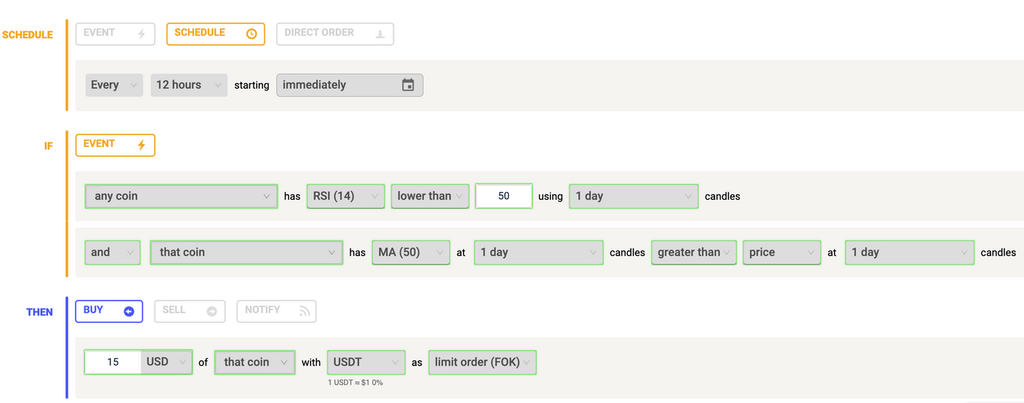
Coinrule template screenshot. Read the schedule together with the entry conditions to see when a buy can actually happen.
The template also has a sell rule. Read both sides before enabling it. Someone who wants to keep every purchase in a long-term wallet may find the entry logic attractive and the exit logic unsuitable. Write down one situation in which you expect a buy and one in which you expect the rule to wait. Compare those expectations with every condition in the template, including the currency and amount spent. That exercise makes a template easier to assess than a historical return figure.
Coinrule is a good fit for an investor who wants to edit the conditions in plain sight. It is harder to justify if the only instruction is “buy on Monday.” A built-in recurring order already covers that job and leaves fewer settings to maintain.
What a bot subscription costs on a small DCA budget
Put the software fee beside the amount you intend to buy each month. For illustration, suppose a subscription costs $20 per month. On $200 of monthly purchases, software alone adds 10 cents per dollar invested. On $2,000 it adds one cent. These are hypothetical figures. Exchange trading fees, spreads and any withdrawal costs sit on top. If a monthly budget of $200 includes the subscription, only $180 remains for purchases before exchange costs.
For a fair comparison, choose an actual plan that supports your exchange and required number of bots. Divide its monthly cost by your expected purchases. If a condition triggers rarely, use the amount likely to be spent: a $20 fee against $100 of filled buys amounts to 20%. A discounted annual plan changes the calculation again if you stop using it after three months. The useful number is what you pay across the months you actually trade.
Which setup fits your next purchase?
Start with the instruction you would give another person. “Buy €100 after my salary lands” points toward a funded recurring order. “Spend $100 across three lower prices” calls for an order ladder. “Check twice a day and buy only below my chosen indicators” calls for a rule builder. Write down what should happen after the first purchase as well. Keeping the asset, selling at a target and starting another cycle leave you with different holdings even when the opening buy is identical.
Which app gives you more bitcoin for the same cash?
Open two previews close together. Choose the same asset, cash amount, currency and funding method. Record the total debit and the quantity due. Divide the total debit by the bitcoin quantity to get the effective price per BTC. This captures a fee deducted from the order as well as differences in the quoted purchase price. Check your bank statement separately for charges outside the preview.
Imagine both apps debit $50. One quotes 0.000500 BTC and the other quotes 0.000495 BTC. The first delivers 500 more satoshis. The effective prices are $100,000 and about $101,010 per BTC respectively. These figures illustrate the calculation only. Live prices move, and neither preview locks in the price of future purchases.
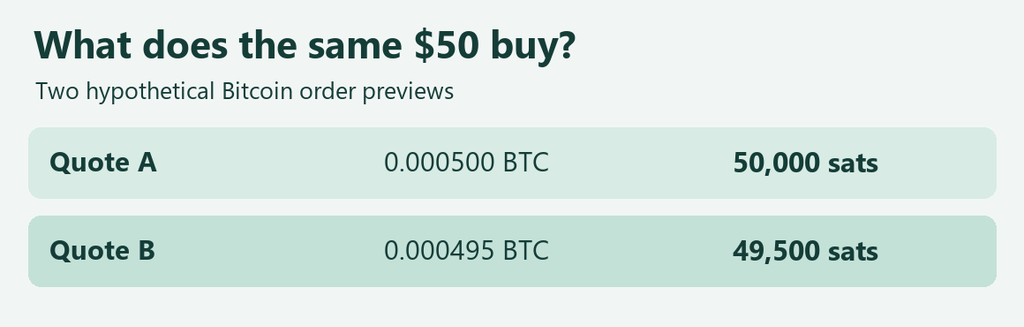
| Example | Total debit ÷ BTC received | Effective price per BTC |
| Quote A | $50 ÷ 0.000500 | $100,000 |
| Quote B | $50 ÷ 0.000495 | ≈ $101,010 |
If you send purchases to your own wallet, compare the quantity that arrives there too. Record the withdrawal charge separately and compare the same network on each app. Buying weekly and withdrawing monthly produces a different cost per contribution from withdrawing after every buy.
Before the second purchase
Keep the first receipt and find the next scheduled date in the app. Compare the cash debited, the fee and the crypto credited with your preview. Then check whether the next debit comes before or after your next paycheck. This catches an immediate setup purchase, a calendar mismatch or a bank conversion charge while you still have just one order to reconcile.
For the underlying calculation and a worked example of how price changes affect your holdings, read our guide to crypto dollar-cost averaging. Scheduled purchases can still lose value, including after several buys at progressively lower prices.
Frequently asked questions
What is the best crypto DCA app for beginners?
Start with the app whose first payment you can predict. Kraken gives you control over the start date. Coinbase works well if you want to buy today and continue on its preset dates. Bitpanda is a candidate for euro direct debit if you can keep funds available ahead of the investment date.
Which crypto DCA app has the lowest fees?
There is no single lowest price established by this comparison. Obtain simultaneous previews for the amount you actually intend to spend. For a $25 weekly buy, use $25 in both previews and compare the units delivered for the total debit. Include withdrawal costs if your goal is bitcoin in your own wallet.
Do I need a DCA bot to buy crypto every month?
No. Kraken, Coinbase and Bitpanda can each schedule a fixed monthly purchase. A trading bot becomes a separate decision if you want rules such as placing another order after a price drop. That rule can change how much cash you commit in a month.
What happens if I cancel before the next buy?
Check both the recurring instruction and pending transactions. Bitpanda warns that pending purchases can still settle after cancellation. On Coinbase, canceling or changing your future schedule cannot undo the initial purchase that executed when you confirmed it.