
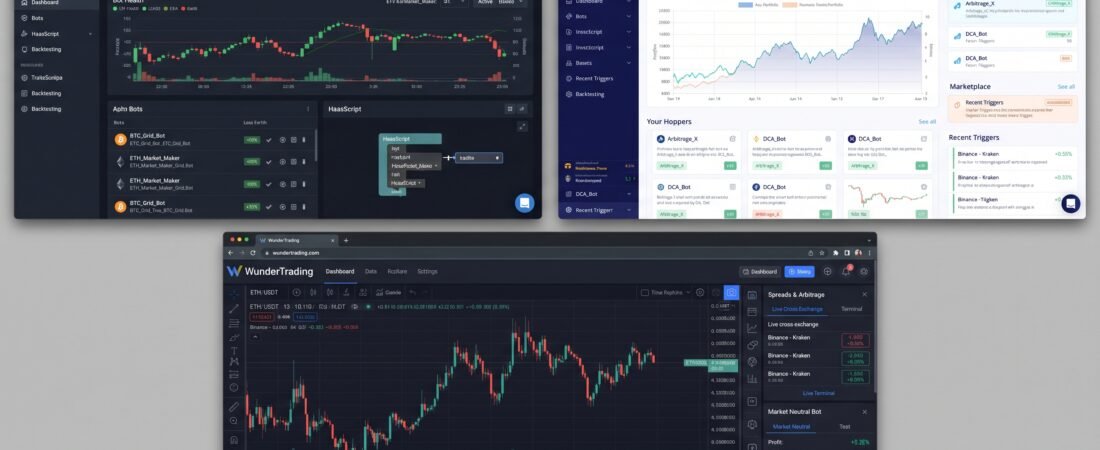
It is another wild year for cryptocurrencies, and everybody is still looking for an edge in this unpredictable market. Today we are going to talk about one of the lowest-risk ways to trade crypto – arbitrage trading. While the days of effortless 2% price gaps are mostly behind us, using the right software can still turn small market inefficiencies into steady returns. Join us and learn about the best crypto arbitrage trading platforms available right now!
What is crypto arbitrage trading?
Crypto arbitrage is a trading strategy that involves simultaneously buying and selling cryptocurrencies across different markets to profit from temporary price differences. In plain terms, you buy a coin where it is cheap and sell it where it is trading higher.
Because price gaps close within seconds, arbitrage usually delivers small returns on each individual trade – often between 0.1% and 0.6%. To make it work, you have to execute orders fast before other traders or market makers close the spread. Doing this manually by logging into multiple exchanges, checking order books, and clicking buy and sell at the same time is nearly impossible.
To actually stay profitable, most retail traders rely on automated arbitrage platforms that connect to your exchange accounts via API keys. Before picking one, it also helps to know the three main styles these bots run:
- Cross-exchange arbitrage: Holding balances on two different exchanges (for example, Binance and Kraken) so your bot can buy on one and sell on the other at the exact same moment without waiting for slow blockchain transfers.
- Triangular arbitrage: Exploiting price mismatches between three trading pairs on a single exchange (like BTC/USDT, ETH/BTC, and ETH/USDT), which avoids withdrawal fees completely.
- Funding-rate (spot-futures) arbitrage: Buying a coin on the spot market while simultaneously opening an equal short position in perpetual futures to collect funding fees every few hours.
The best and most popular platforms for handling these strategies are:
| Feature | WunderTrading | Cryptohopper | HaasOnline | Pionex |
| Cheapest arbitrage plan / month | $39 USD* | $129 USD* | $49.99 USD* | $0 (0.05% trading fee) |
| Automated arbitrage trading? | Yes | Yes | Yes | Yes |
| Arbitrage type | Cross-exchange & Spread | Cross-exchange & Triangular | Custom / Multi-pair | Spot-Futures (Funding) |
| Exchanges supported | 15+ | 15+ | 20+ | Built-in (Aggregated liquidity) |
| Free trial / Free tier | Free plan + 7-day Pro trial | 3-day free trial | 7-day free cloud trial | Free built-in bots |
*Monthly billing rates; annual subscriptions typically knock 15% to 25% off the price.
WunderTrading
WunderTrading has grown into one of the most practical multi-exchange automation platforms on the market, especially since older all-in-one terminals like Bitsgap phased out their dedicated arbitrage tools. Built for traders who want clean execution without writing code, it connects to major exchanges like Binance, Bybit, OKX, Kraken, and even decentralized perpetuals like Hyperliquid.
When it comes to arbitrage, WunderTrading gives you a dedicated Spreads & Arbitrage terminal alongside its Market Neutral bot. You pick a Base exchange to buy the asset and a Quote exchange to sell it, set your position allocation, and let the system fire both legs at once. It also supports Limit-Market entries, which helps cut down on expensive exchange taker fees that normally eat into thin arbitrage margins.
Pricing starts with a permanent Free plan that lets you test basic bots and run 1 multi-API trade. The Basic plan at $19 / month bumps you up to 2 multi-API trades and 5 signal bots.
If you want serious arbitrage capacity, the Pro plan at 39–49 / month (depending on billing region and cycle) unlocks 10 multi-API trade slots, 50 signal bots, and full Open API access. The top Premium tier at 69–99 / month removes almost all limits, giving you 50 multi-API trades and up to 5 dedicated Market Neutral bots.
If you want to test WunderTrading’s arbitrage terminal before paying anything, you can claim a 7-day free trial on the Pro plan.
Cryptohopper
Cryptohopper is one of the longest-running names in the crypto bot space. Started by two brothers for their own personal trading, it has turned into a massive cloud-based automation hub that connects to major venues like Binance, Kraken, Coinbase Advanced, Bybit, and KuCoin.
Arbitrage on Cryptohopper works without ever moving coins between exchanges during a trade. You keep balances on two or more connected exchanges, and the bot scans order books for price discrepancies, buying on one and selling on the other simultaneously. It also includes a Triangular Arbitrage bot that hunts for price loops within a single exchange.
Cryptohopper no longer offers its old permanent free Pioneer tier, though new accounts get a 3-day free trial on the Explorer package. The Explorer plan costs $29 / month ($24.16/mo billed annually) and lets you trade up to 15 coins with 80 open positions, though arbitrage is not included.
The Adventurer plan at $69 / month ($57.50/mo billed annually) expands your limits to 50 coins, 200 open positions, and faster 5-minute strategy checks, making it great for standard indicator trading.
However, if you specifically want Cryptohopper’s Exchange Arbitrage and Triangular Arbitrage bots, you now need the Hero package at $129 / month ($107.50/mo billed annually). Along with full arbitrage tools, Hero unlocks 75 coins, 500 open positions, 2-minute scanning intervals, and AI strategy designers. It is pricier than it used to be, so it makes the most sense if you are trading with a larger bankroll.
HaasOnline
HaasOnline has been around since 2014, making it one of the veterans of crypto trading software. Unlike simpler beginner platforms, HaasOnline is built for traders who want deep customization and fast execution across 20+ exchanges.
HaasOnline’s arbitrage bots monitor selected pairs across connected exchanges and execute trades automatically the moment your spread conditions are met. Because everything runs automatically on their TradeServer Cloud – or on your own private server if you use their Enterprise setup – human hesitation is completely removed from the equation. For power users, their proprietary HaasScript language lets you code custom arbitrage rules from scratch.
Pricing is much more accessible now than in the days when subscriptions were pegged to Bitcoin. The Starter plan costs $19.99 / month and covers basic bot automation and Smart Trade tools, though full arbitrage setups work best on higher tiers.
The Standard plan at $49.99 / month unlocks 10 active bots, 6 months of historical backtesting, and market intelligence tools. The Pro plan at $99.99 / month opens up 25 trade bots, 12 months of backtesting, and full scripting flexibility.
HaasOnline has one of the widest toolkits in the industry, and with a 7-day free trial on TradeServer Cloud Standard, you can test your setups in paper-trading mode before risking real money.
Pionex (Best Free Alternative for Funding Arbitrage)
If paying $50 to $130 a month in subscription fees eats too much into your capital, Pionex is worth a serious look. Rather than being a third-party bot you connect via API keys, Pionex is a full cryptocurrency exchange with 16 trading bots built straight into the platform at zero subscription cost.
Pionex does not do cross-exchange arbitrage between outside platforms. Instead, it specializes in Spot-Futures Arbitrage. The bot buys crypto on the spot market and simultaneously opens a short perpetual futures contract of the exact same size. Because the two positions cancel out price swings, you stay market-neutral while collecting funding rate payouts every 8 hours.
There are no monthly tiers to worry about – you only pay Pionex’s flat 0.05% spot trading fee (and standard futures maker/taker fees). While returns fluctuate depending on whether the market is bullish or bearish, it remains one of the easiest ways for smaller accounts to run market-neutral arbitrage without worrying about API rate limits or monthly software bills. (Note: If you still prefer a dedicated inter-exchange scanner over a single-exchange bot, niche terminals like Arbinox also remain active for two-legged statistical arbitrage.)
A quick reality check before you start
Arbitrage is much safer than guessing whether Bitcoin will pump or dump overnight, but it is not free money. Before turning a bot loose on your account, keep three things in mind:
- Exchange fees matter more than bot fees: If a spread between two exchanges is 0.30%, and each exchange charges you a 0.10% taker fee on your buy and sell orders, two-thirds of your profit disappears immediately. Always use exchanges where you have VIP fee discounts or native token fee reductions.
- Account size counts: Paying $129 a month for a Hero plan on a $1,000 portfolio means your bot has to make nearly 13% every single month just to break even on software costs. Start with free trials or low-fee options until your capital justifies higher tiers.
- Keep balances pre-funded: Never rely on transferring coins between blockchains to catch a price gap. By the time a network confirms your deposit, the price difference will be long gone. Keep USDT and the coins you plan to trade sitting ready on both exchanges.
Crypto Arbitrage Platforms – FAQs
Is it safe to connect my exchange accounts to an arbitrage bot?
Yes, as long as you configure your API keys properly. When generating an API key on Binance, Kraken, or Bybit, only enable Read and Spot/Futures Trading permissions—never check the box for Withdrawals. Even if a third-party platform suffers a breach, nobody can move funds off your exchange account without withdrawal access. Adding IP whitelisting on the exchange side locks things down even further.
Is crypto arbitrage legal, and how is it taxed?
Arbitrage trading is completely legal across most jurisdictions and actually helps exchanges keep their prices aligned. However, high-frequency bot trading creates a massive paper trail for taxes. In most countries—including the US and across the EU under DAC8 reporting rules—every single buy, sell, or crypto-to-crypto swap counts as a taxable disposal event. Make sure your bot platform supports clean CSV exports or connects directly to crypto tax software so you are not stuck reconciling thousands of micro-trades manually at the end of the year.
What happens if one side of my arbitrage trade fails to fill?
This is known as “execution risk” or getting “legged out,” and it happens when a price disappears on Exchange B milliseconds after your bot buys on Exchange A. Good arbitrage terminals handle this in one of two ways: they either immediately place a fallback market order to close the exposure at a tiny loss, or they hold the position until the spread returns. Stick to high-liquidity pairs (like BTC, ETH, or SOL) where order books are deep enough to absorb your trade without partial fills.
Do I need a VPS (Virtual Private Server) to run these bots?
Not for cloud-based platforms like WunderTrading, Cryptohopper, or Pionex—their servers run 24/7 even when your laptop is turned off. The only time a VPS makes sense is if you run self-hosted desktop software (like HaasOnline’s local Enterprise server) and want to place your server geographically close to an exchange’s matching engine (such as Tokyo or Frankfurt) to shave a few milliseconds off order latency.
Can I run crypto arbitrage on decentralized exchanges (DEXs) instead?
You can, though the mechanics are totally different. On DEXs like Uniswap or Raydium, arbitrage is dominated by MEV (Maximal Extractable Value) bots that compete directly inside blockchain blocks using custom smart contracts and priority gas fees. The retail platforms listed above are built for centralized exchanges (and select order-book perpetual DEXs like Hyperliquid) rather than automated on-chain flash loans.